
Sanatoria, Condono or Salva Casa? Legalising Building Works in Italy
- Salva Casa
- Sanatoria
- Condono
- Building compliance
- Buying property in Italy
"There's a small irregularity, but the new Salva Casa law will fix it." Foreign buyers hear this from sellers and agents all the time. Sometimes it's true. Often it isn't.
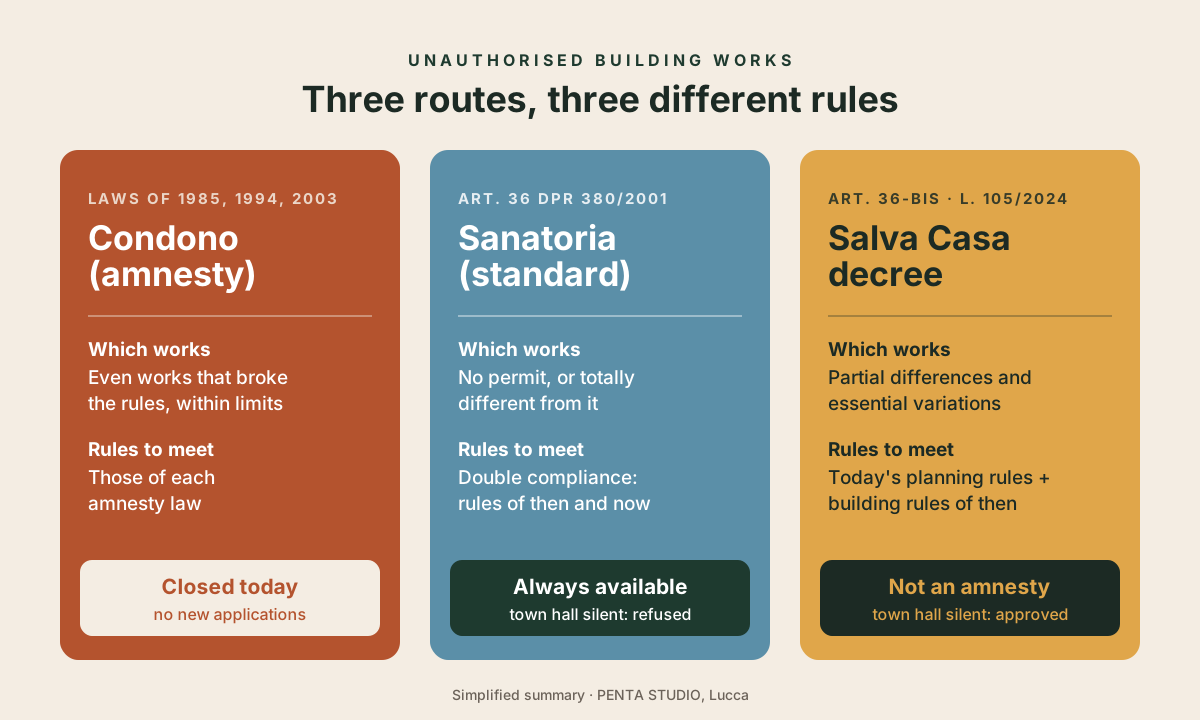
In Italy, unauthorised building works can be dealt with in three very different ways: the condono (building amnesty), the sanatoria (retrospective permit) and the Salva Casa decree of 2024. Mixing them up can lead you to buy a house you think you can legalise, and then find out you can't.
I'm Salvatore La Rocca, a geometra and technical expert for legal matters based in Lucca. Here is how the three routes work, in plain English.
The condono: an amnesty that has closed
The condono was an extraordinary amnesty. The Italian State opened it three times, with special laws:
- Law 47/1985, the first condono;
- Law 724/1994, the second;
- Decree-Law 269/2003 (converted into Law 326/2003), the third.
Each law covered works completed by a set date and gave owners a limited window to apply. Its key feature: it could legalise works that broke the planning rules, within size limits and with exclusions for protected areas. In Tuscany, the third condono was applied with stricter limits set by regional law.
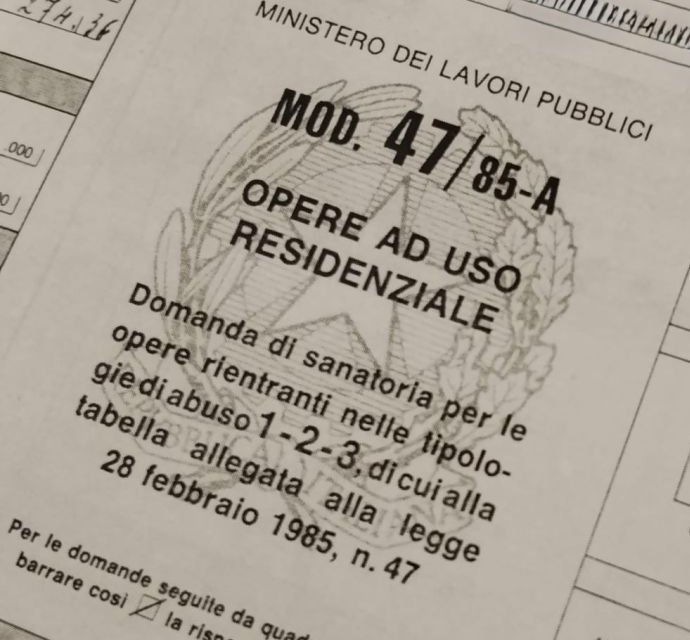
The form used to apply for the first condono in 1985. Files like this one still sit in town hall archives.
The condono is closed today. No new applications can be made, and Salva Casa did not reopen it. Applications filed back then and never completed can still be concluded, though, and I often find them in the archive when I check a house before a purchase. An open condono file is not a problem in itself, but it has to be completed, and that takes time and money.
The sanatoria: always available, but with double compliance
The standard sanatoria, called accertamento di conformità, is set out in Article 36 of the Italian Building Code (DPR 380/2001). There is no deadline: you can apply at any time.
The condition is double compliance (doppia conformità). The works must meet:
- the planning and building rules in force when they were carried out;
- the rules in force when you apply.
If either one fails, the works cannot be legalised. It is a strict test: an extension that met the old town plan but not today's, for example, does not pass.
Since Salva Casa, Article 36 applies to works carried out with no permit or completely different from the permit. You pay a fee (oblazione), and if the town hall does not reply within 60 days, the application is refused.
The Salva Casa decree: what really changed
Decree-Law 69/2024, converted into Law 105/2024, is known as "Salva Casa" ("save the house"). It is not an amnesty: it does not legalise works that break today's planning rules. But it made many common situations much easier to fix, especially the small differences between the approved drawings and the house as built. I explain these differences in On Paper vs On Site: Does the House Match the Approved Drawings?
1. An easier sanatoria for partial differences
The decree added Article 36-bis to the Building Code. It covers works partly different from the permit, essential variations and works that needed a SCIA filing.
The difference from the standard sanatoria is the compliance test:
- the planning rules (what can be built, how much, and for what use) must be met today;
- the building requirements (heights, openings, construction standards) must have been met at the time the works were carried out.
The town hall has fixed deadlines to reply: if it doesn't, the application is approved by silence (silenzio-assenso). It can also require adjustment works, structural ones for example, or the removal of the parts that cannot be legalised. A fee is due here too, depending on the type of works.
2. Wider tolerances
Not every difference between drawings and reality is a breach. The law allows tolerances: small measurement differences that do not count as a violation (Article 34-bis of the Building Code).
For works carried out by 24 May 2024, Salva Casa widened them according to the floor area of the unit:
| Floor area of the unit | Tolerance |
|---|---|
| over 500 m² | 2% |
| 300 to 500 m² | 3% |
| 100 to 300 m² | 4% |
| 60 to 100 m² | 5% |
| under 60 m² | 6% |
A room slightly larger than on the plans, a wall moved by a few centimetres, a window a little different: in many cases these now fall within the tolerances and only need to be declared by a technician, with no sanatoria.
3. Proving the legal status is easier
The decree also changed Article 9-bis on the legal status (stato legittimo) of a building. Under certain conditions, the permit for the last works on the whole building is enough, as long as the town hall checked the earlier permits when it issued it. For very old houses, built when no permit was needed, the rules I explain in Old House, No Building Permit on File? It May Still Be Perfectly Legal apply.
What Salva Casa does not fix
This is the most important part, and the one you hear least about. Salva Casa does not legalise:
- works built with no permit at all that break today's planning rules;
- new volume the town plan does not allow, such as an extra floor or an extension beyond the limits;
- works that conflict with protection rules that allow no exceptions.
For these, only the standard sanatoria with double compliance remains. If that fails too, the works have to be removed or reduced.
What about Tuscany?
Salva Casa is a national law, but in Tuscany the regional planning law (L.R. 65/2014) and each town's own rules also apply. In areas under landscape protection, which cover much of the Tuscan countryside, a landscape compatibility check is also needed. That is why every case has to start from the rules of the town where the house stands.
What this means if you are buying
If the house you want has an irregularity, three questions decide what can be done:
- What kind of difference is it? A measurement outside the tolerances, a partial difference, or works with no permit?
- When were the works done? The date decides which rules applied and whether the new tolerances count.
- What do today's rules say? Town plan, landscape protection and seismic rules.
To answer them, someone has to compare the drawings filed at the town hall, the cadastral plan and the house itself. That is the check I do before every purchase, and it is one of the 7 technical checks to make before you sign. If you plan to renovate after buying, read CILA, SCIA or Building Permit: which application do you need?
Frequently asked questions
Can I still apply for a condono?
No. The last condono closed to new applications in 2004. Only applications filed back then and never completed can still be concluded.
Does Salva Casa legalise every irregularity?
No. It makes partial differences easier to legalise and widens the tolerances, but it does not legalise works that break today's planning rules.
Can a house with an irregularity be sold?
It depends on the irregularity. Small differences do not always block the deed, but the buyer inherits the problem, and a bank may refuse the mortgage. Check, and legalise where possible, before the preliminary contract (compromesso).
Who pays to legalise the works?
It is a matter for negotiation. If the check finds an irregularity before you sign, you can ask the seller to legalise it before the deed, or agree a lower price that covers the cost.
Found a house with "a small irregularity"?
Send me the listing or the address. In a free 15-minute video call, in English, we look at what the irregularity is and whether it can be legalised, before you commit to anything.
This article is general information, not legal advice. Rules and how they are applied can change and vary from town to town.
Share this article
Need technical advice on a property in Italy?
Tell us about your project: we will reply within 24 hours, in English.
Book a free 15-min call