
A 1920 Map on Today's Satellite Photo: Why Property Boundaries in Italy Are a Century Old
- Property boundaries
- Catasto
- Old maps
- Buying land in Italy
- Lucca
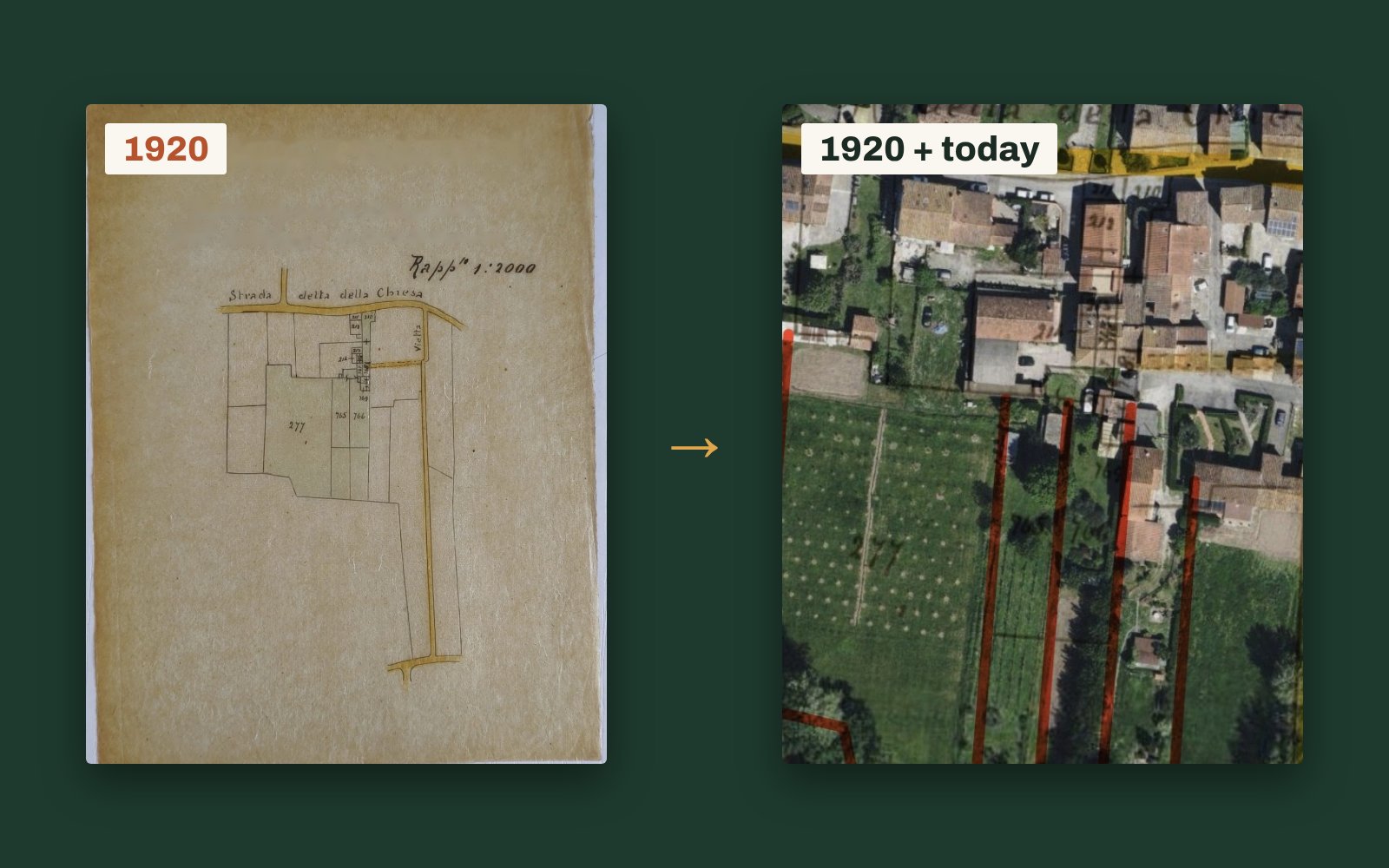
A tracing from around 1920. A satellite photo from today. Lay one on top of the other, and the road, the lane and the field boundaries are still exactly where they were.
I'm Salvatore La Rocca, a geometra in Lucca. Reading old maps is part of my job, and this one is a good example of why. In Italy, land keeps its history on paper, and that history still decides what you are buying today.
The map
The tracing is drawn by hand, in ink and watercolour, on thin paper. It shows a few plots in the plain just outside Lucca, at a scale of 1:2000:
- the "Strada detta della Chiesa", the road to the church, coloured in yellow;
- a "Vietta", a narrow lane running south between the fields;
- the plots, each with its own number, such as 277, 765 and 766, and a cluster of small buildings along the road.
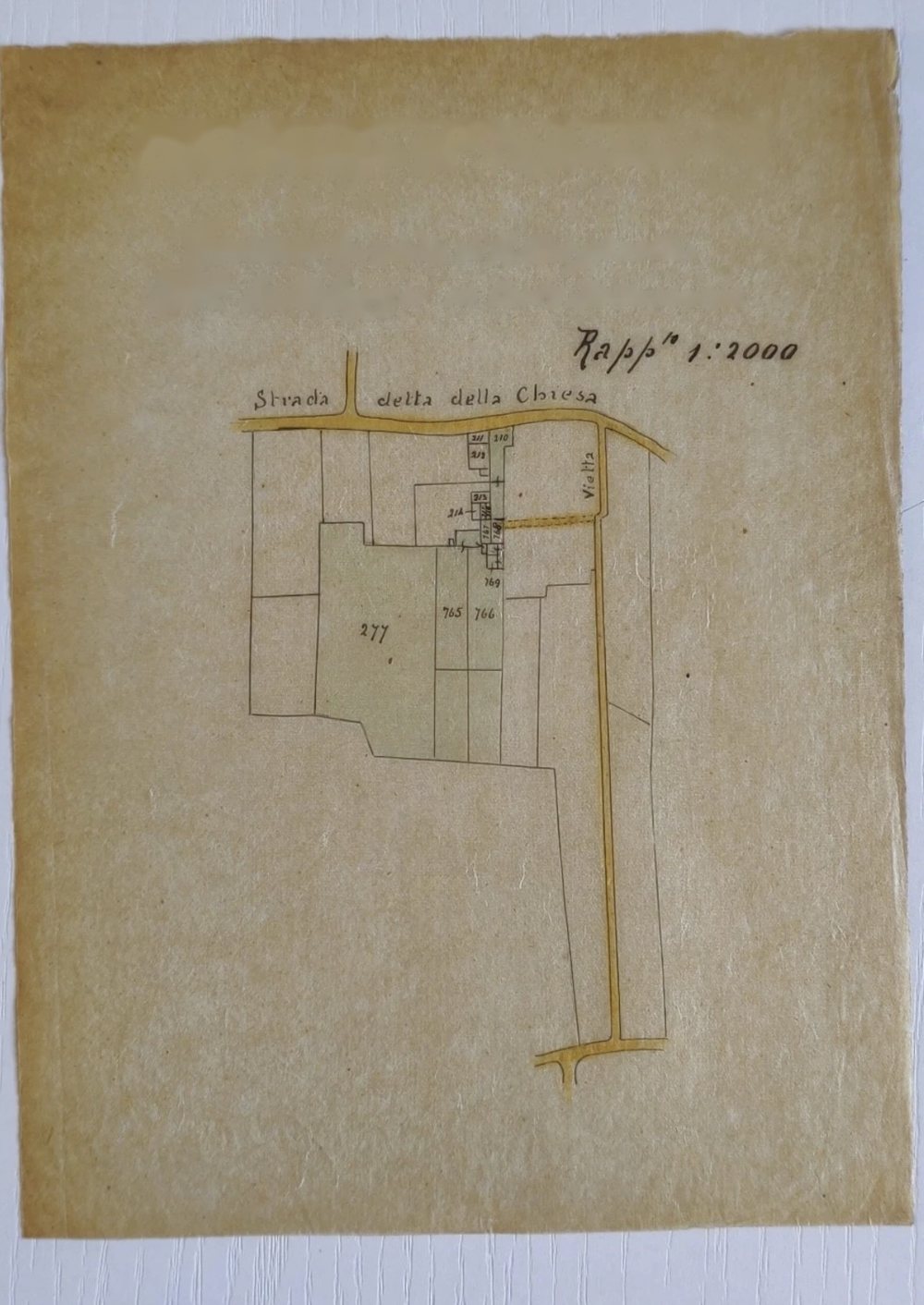
It is a tracing from the land registry maps. Copies like this were made by hand when land was sold, split or inherited, and they often survive in old deeds and family papers.
The overlay
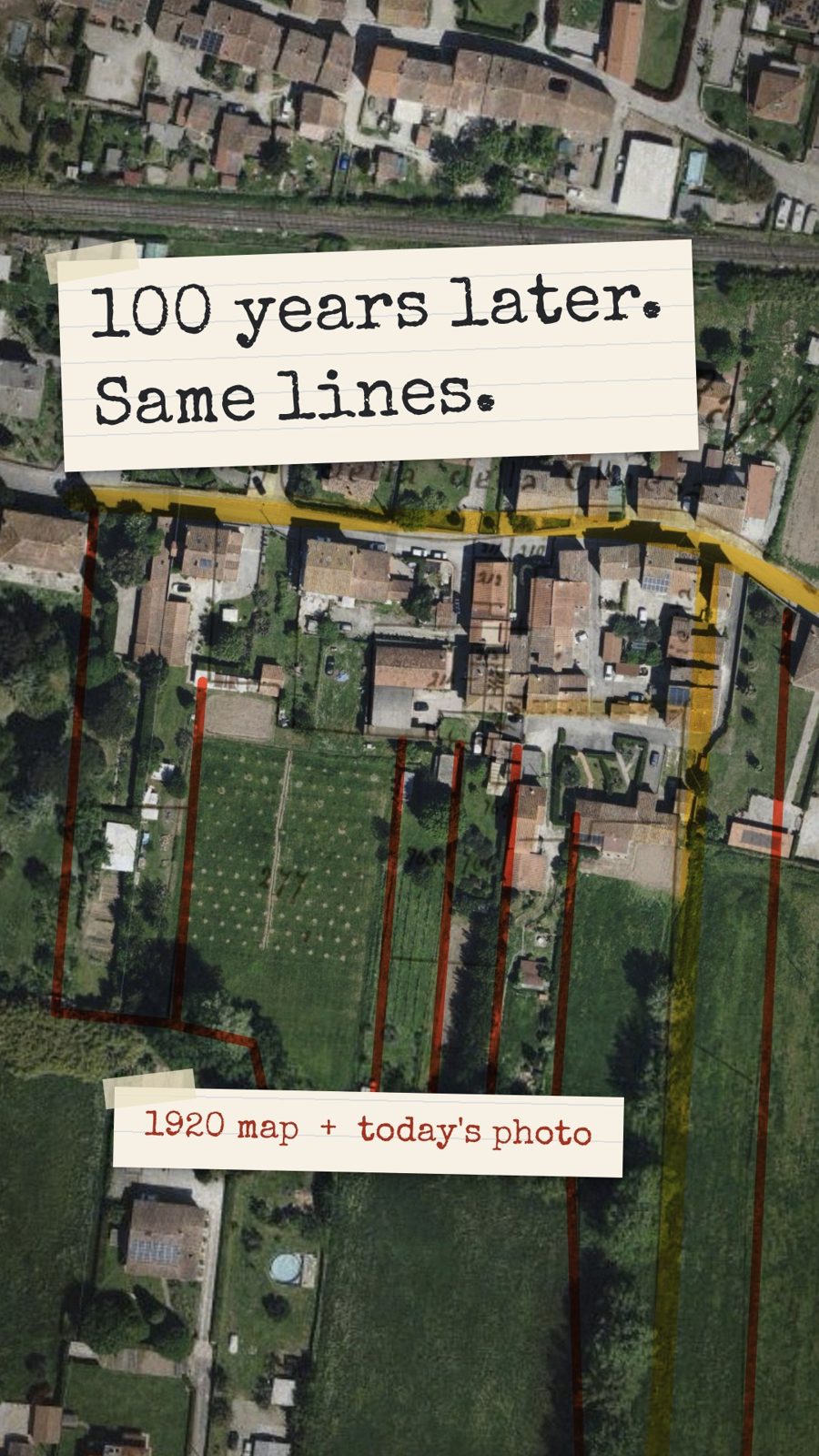
To compare the map with today, I scaled it to match a recent satellite photo, using points that have not moved: the road, the oldest buildings, the line of the railway.
The result is striking:
- the road follows exactly the same curve;
- the lane is still there, now a strip between gardens and fields;
- the field boundaries, the long narrow strips typical of the plain around Lucca, still run where they ran a hundred years ago, now marked by hedges, fences and rows of trees.
Why this matters when you buy
The boundaries you buy were drawn long ago
When you buy a house with a garden, an olive grove or a field, you are buying plots that were often defined generations ago. Houses get rebuilt, fences get moved, hedges grow. The lines on paper stay.
That is why I always check that what you see on site matches what you are actually buying.
The catasto map is not a title deed
In Italy the land registry (catasto) was created for taxation. Its maps are an essential reference, but they do not by themselves prove who owns what: ownership comes from the deeds. When the deeds are unclear, Italian law (art. 950 of the Civil Code) lets a judge fall back on the cadastral maps to settle a boundary. In other words, old maps still matter, even in court.
The fence may not be on the boundary
It is common to find a fence, a wall or a hedge that does not follow the boundary on the map. Sometimes the difference is a few centimetres; sometimes a whole strip of garden is in the wrong place. And if a neighbour has used a strip of land as their own, openly and without interruption, for twenty years, they may have acquired it by adverse possession (usucapione).
The lane may be someone else's
A lane like the Vietta on this map may cross other people's land. If it is the only way to reach the house, you need to know whether your right to use it is written down (servitù di passaggio) and who maintains it. I wrote about this for farmhouses in Buying a stone farmhouse in Chianti: the technical checklist.
Old maps can prove an old house is legal
Historic maps are also evidence of when a building already existed. For houses built before permits were required, they help prove that the house is legal: see Old House, No Building Permit on File? It May Still Be Perfectly Legal.
What I check before you buy
- The documents: the deeds, the cadastral map and plans, and any old tracings or splits of the land.
- The history: older cadastral maps and historic records, to see how the plots were formed.
- The overlay: the maps laid over current aerial photos, as a first check of boundaries, lanes and buildings.
- The site: whether fences, walls, lanes and buildings match what is on paper.
An overlay is a first check, not a boundary survey. If the boundaries matter, for example because you plan to build, fence or split the land, I carry out a survey on site with instruments, tied to the official reference points of the catasto.
If you are buying from abroad, see how I work in Buying in Lucca from abroad.
Frequently asked questions
Is the cadastral map proof of what I own?
Not on its own. Ownership comes from the deeds; the cadastral map is a reference, and a judge can rely on it when the deeds don't settle a boundary.
Can the boundaries on the map be wrong?
Old maps were drawn by hand and at small scales, so small differences are normal. What matters is whether the boundaries on site broadly match the deeds and maps, and whether anyone else claims part of the land.
Where do you find old maps like this?
In old deeds and family papers, in the archives of the catasto, and in historic archives. Part of my work is knowing where to look.
Do I need a boundary survey to buy a house?
Not always. For an apartment, almost never. For a house with land, a garden on a lane, or a plot you want to build on or fence, it is often worth it, and much cheaper before the deed than in a dispute afterwards.
Buying a house with land near Lucca?
Send me the listing or the address. In a free 15-minute video call, in English, I'll tell you what the maps and the documents need to show before you sign. I work in Lucca and nearby towns: Capannori, Porcari, Altopascio, Montecarlo, Massarosa, Camaiore, Pescaglia, Borgo a Mozzano, and San Giuliano Terme and Vecchiano towards Pisa.
This article is general information, not legal advice on your specific case.
Share this article
Need technical advice on a property in Italy?
Tell us about your project: we will reply within 24 hours, in English.
Book a free 15-min call