
Buying Property in Italy as a Foreigner: The Step-by-Step Process
- Buying property in Italy
- Foreign buyers
- Notary
- Compromesso
- Tuscany
The short answer
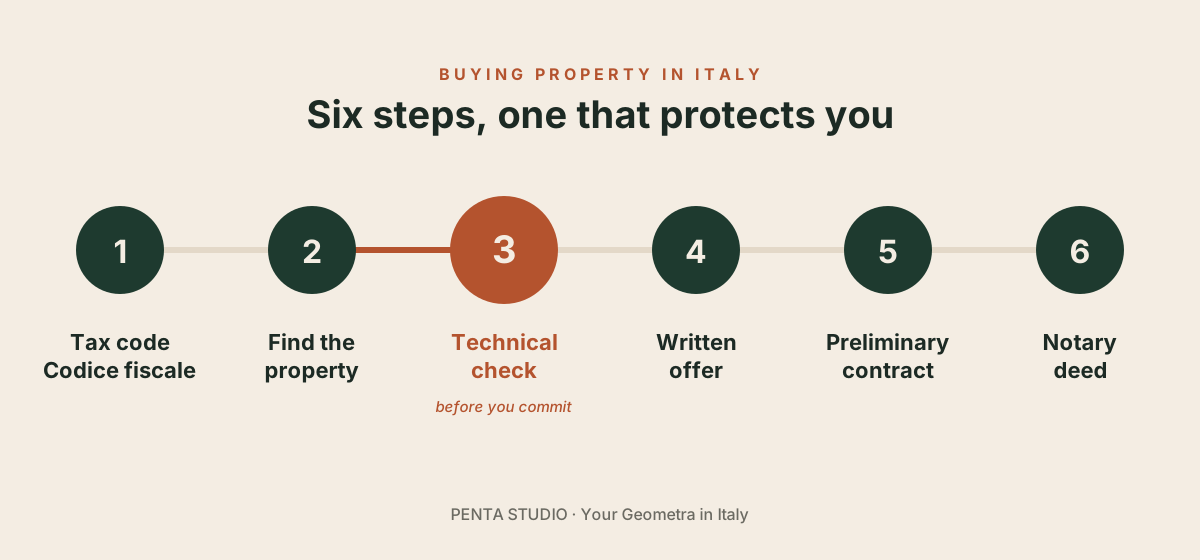
Buying property in Italy as a foreigner follows the same steps as for Italians: get a tax code (codice fiscale), make a written offer, sign a preliminary contract (compromesso) with a deposit, and complete the purchase with the final deed (rogito) in front of a notary. Most foreigners can buy freely. The step that most buyers skip, and regret, is the technical check of the property before the preliminary contract.
I'm Salvatore La Rocca, a geometra and law expert based in Lucca. I help foreign buyers across Tuscany check houses before they sign. Here is the whole process, step by step, and where each professional fits in.
Can foreigners buy property in Italy?
Yes. Citizens of the European Union and the EEA can buy property in Italy on the same terms as Italians. Citizens of other countries can buy if there is a reciprocity agreement with their country, which is the case for most buyers I work with, including those from the UK, the United States, Canada and Australia. Foreigners legally resident in Italy can always buy. If you are unsure about your country, the Italian Ministry of Foreign Affairs publishes the reciprocity rules.
Step 1. Get your codice fiscale
The codice fiscale is the Italian tax code. You need it to make an offer, sign contracts, open a bank account and pay taxes. You can request it from the Agenzia delle Entrate in Italy or from the Italian consulate in your country. It is free and usually quick.
An Italian bank account is not strictly required, but it makes everything easier: payments for the property must be traceable, and the deed records exactly how the price was paid.
Step 2. Find the property
Most properties are sold through an estate agent (agente immobiliare). In Italy the agent is usually paid by both buyer and seller, with a commission agreed in advance. Ask about it before you visit, and make sure the agent is registered.
Remember that the agent's job is to sell the property. Nobody in the sale is checking the building for you, unless you appoint someone to do it.
Step 3. Check the property before you commit
This is the step that protects you. Before you sign anything binding, a geometra checks:
- that the house matches the permits filed at the town hall;
- that the cadastral plan matches the house, as the deed requires;
- what you can change, given landscape, historic-centre and seismic rules;
- the condition of the building and the hidden costs.
I explain these checks in detail in Buying a House in Tuscany: 7 Technical Checks to Make Before You Sign. If the house is old and has no permit on file, read Old House, No Building Permit on File? It May Still Be Perfectly Legal.
My advice: make your offer conditional on a satisfactory technical check, or have the check done before the offer if you can.
Step 4. Make a written offer
The offer (proposta d'acquisto) is usually made in writing through the agent, often with a small deposit. Once the seller accepts and you are informed, it can become binding. Read it carefully, ask for a translation if you need one, and include any conditions, such as the technical check or a mortgage.
Step 5. Sign the preliminary contract
The preliminary contract (compromesso) sets the price, the timing and the conditions of the sale. With it you usually pay a larger deposit (caparra confirmatoria). If you walk away without a valid reason, you lose it; if the seller walks away, they must pay it back double. The contract must be registered with the tax office.
This is the point of no return. Every problem you discover after the compromesso costs you money or negotiating power.
Step 6. The final deed with the notary
The purchase is completed with the final deed (rogito), signed in front of a notary (notaio). The buyer usually chooses the notary. The notary checks ownership, mortgages and the legal documents, collects the taxes and registers the sale.
If you do not speak Italian, the law requires an interpreter at the signing and a translation of the deed. If you cannot be in Italy, you can sign a power of attorney (procura) so that someone signs on your behalf.
What the notary does not do is visit the house and compare it with its permits. That is a technical check, and it is the one I do.
Taxes and costs
The main costs of buying a house in Italy are:
- purchase taxes, which depend on who sells (a private seller or a builder) and on whether the house becomes your main residence (prima casa);
- the notary's fee;
- the agent's commission;
- the technical check, and any work needed to put the documents in order.
For resale homes bought from a private seller, the registration tax is usually calculated on the cadastral value rather than on the price, and it is lower if the house becomes your main residence. Ask the notary for a full estimate early on.
After the purchase
Once you have the keys, you transfer the utilities into your name, register for the local waste tax and, if the house is not your main residence, pay the annual property tax (IMU). If you plan to renovate, every intervention needs the right permit: read CILA, SCIA or Building Permit: which application do you need?
Frequently asked questions
Do I need to be in Italy to buy a house?
No. You can get the codice fiscale through a consulate, have the property checked by a geometra, and sign the deed through a power of attorney. I send my reports in English and we discuss them by video call.
Who chooses the notary?
Usually the buyer, who also pays the notary's fee. Choose one early, so you can ask for the cost estimate and the documents needed.
Is the estate agent checking the house for me?
No. The agent puts buyer and seller together and is paid on the sale. The technical check of the building is a separate job.
When should I contact a geometra?
Before the preliminary contract, ideally before the offer. That is when a check can still change your decision or the price.
Thinking about buying in Tuscany?
Send me the listing or the address. In a free 15-minute video call, in English, we go through the property and what needs checking before you sign. Buying near Lucca? See how I work for buyers who live abroad.
This article is general information, not legal or tax advice. Rules and rates change: ask your notary for the figures that apply to your purchase.
Share this article
Need technical advice on a property in Italy?
Tell us about your project: we will reply within 24 hours, in English.
Book a free 15-min call