
Italy's Renovation Bonus in 2027: 50% or 36%? What the Budget Means for Your Home
- Renovation bonus
- Tax deductions
- Renovating in Italy
- Holiday home
- Tuscany
Updated 5 November 2026. This article describes the 2027 budget bill approved by the Italian government. It becomes final only when Parliament passes the law, by the end of the year. I will update the article once the text is approved.
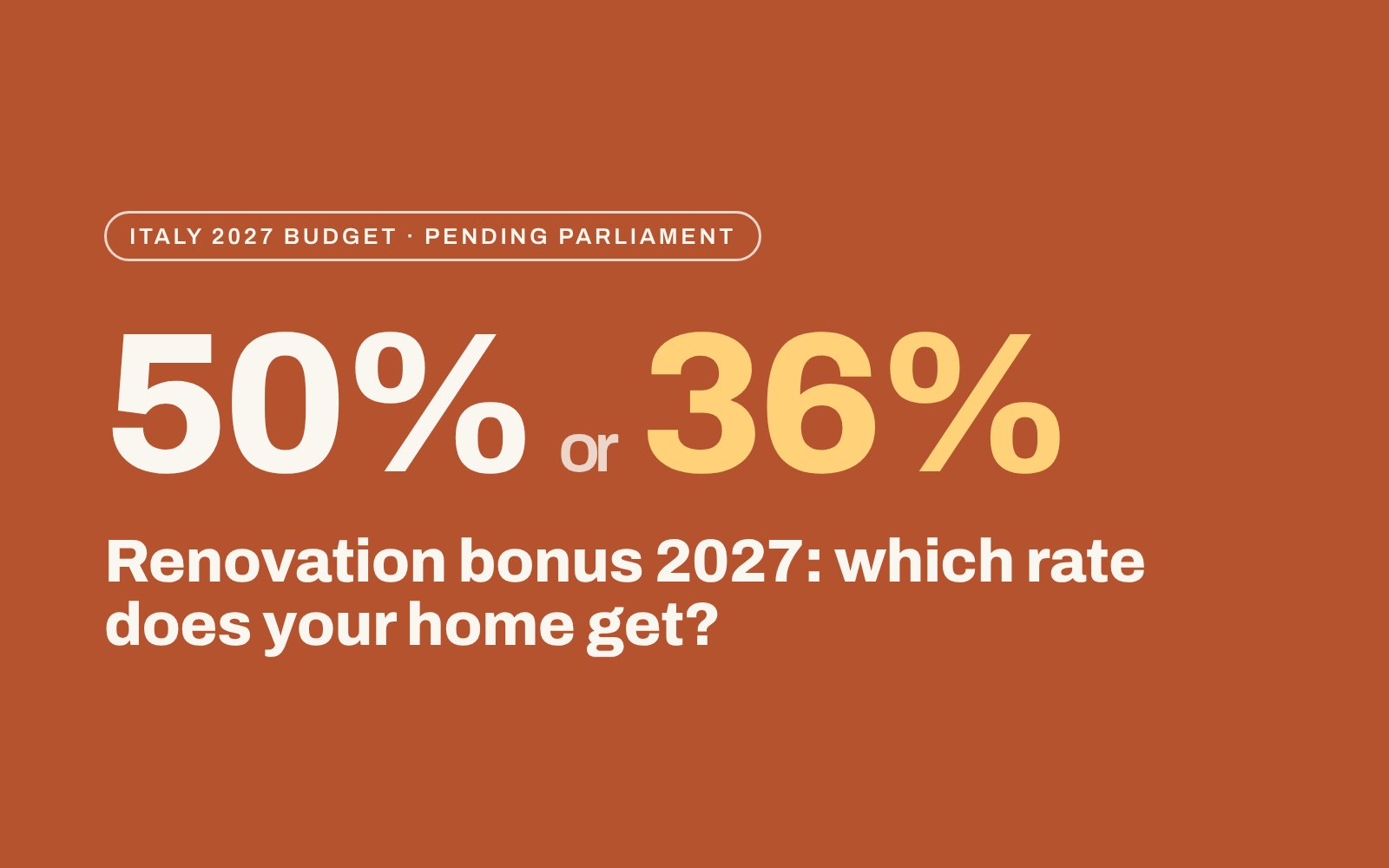
On 28 October the Italian government approved the 2027 budget bill. If you are planning to renovate a home in Italy, there is good news: the renovation tax bonus (bonus ristrutturazione) is not being cut. It stays at today's rates for 2027 spending too.
I'm Salvatore La Rocca, a geometra in Lucca, and many of my clients are foreign owners renovating a house in Tuscany. Here is what the budget says, an example with numbers, and above all what to check before the works start, because the bonus is easier to lose than most people think.
In short
| Main home | Other homes | |
|---|---|---|
| 2027 rate (proposed) | 50% | 36% |
| Spending cap | €96,000 per property | €96,000 per property |
| How you get it back | 10 equal yearly instalments | 10 equal yearly instalments |
Without this extension, the rates would have dropped further in 2027, to 36% and 30%. The budget keeps them at 2026 levels instead.
50% or 36%: it depends on where you live
The higher 50% rate only applies to your main home (abitazione principale): the house where you are officially resident and normally live. For every other home, such as holiday homes, second homes and rentals, the rate is 36%.
For most foreign owners, that means 36%: a house in Tuscany used for a few months a year is not a main home under Italian law.
The €96,000 cap applies per property and covers all the qualifying works done on that home in the year.
An example with numbers
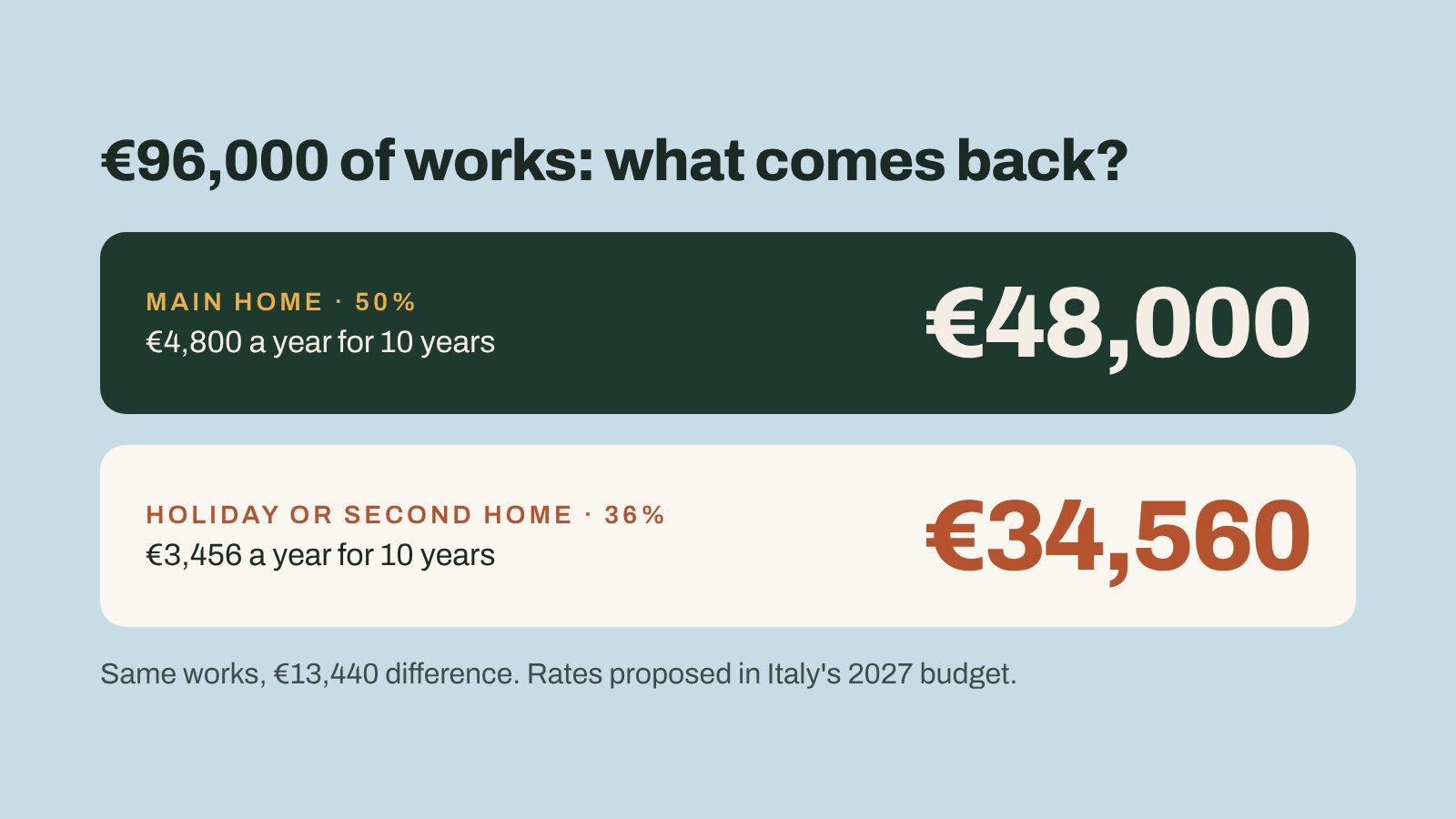
With €96,000 of works, the maximum that qualifies:
- on a main home you get back €48,000, or €4,800 a year for 10 years;
- on a holiday home you get back €34,560, or €3,456 a year for 10 years.
Same works, €13,440 difference.
Moving to Italy? You may get 50%
There is an important exception for people who buy a house, renovate it and then move in. According to the Italian Revenue Agency (circular 8/E of 19 June 2025), the higher rate also applies if the house becomes your main home by the time the works are finished, even if it wasn't when they started.
Watch out on long projects: if the works end before you have moved your residence there, the lower rate applies. Plan the timing of the works and your move together from the start.
Which works qualify
On individual homes, the bonus covers:
- extraordinary maintenance, such as new systems or bathrooms, or a new internal layout;
- restoration and conservation works;
- building renovation.
Ordinary maintenance, such as painting and small repairs, only qualifies on the common parts of an apartment building. To find out which permit each kind of work needs, read CILA, SCIA or Building Permit: which application do you need?
Three conditions to take seriously
1. It's a tax credit, not cash
The bonus is deducted from the Italian income tax (IRPEF) you pay each year, for 10 years. If you have no Italian income tax, or not enough, the unused part is lost: it is not paid out or carried forward. If you live abroad and have no taxable income in Italy, the bonus may be worth little or nothing to you. Check with a tax adviser before counting on it.
2. The works must be properly permitted
This is where a geometra makes the difference. The bonus is refused, and can be withdrawn years later, if:
- the works are carried out without the right building permit (CILA, SCIA or permit);
- the works don't match what was filed;
- the works concern parts of the house that are not legal, such as an extension that was never authorised.
So before you start, the legal status of the house must be checked. If I find irregularities, they need fixing first: see Sanatoria, Condono or Salva Casa? Legalising Building Works in Italy.
3. Pay the right way
Payments must be made by bonifico parlante, a special bank transfer for tax deductions that states the law, your Italian tax code (codice fiscale) and the contractor's VAT number. Keep every invoice and receipt. For some works that save energy, a report to ENEA, the national energy agency, is also needed once the works are finished.
What to do if you are about to renovate
- Check the house before you design anything. Permits, cadastral plan, protection rules: if the house isn't compliant, the bonus is at risk.
- Choose the right permit. CILA, SCIA or building permit, depending on the works.
- Plan the timing. The rate depends on the year you pay, and the 50% depends on when the house becomes your main home.
- Involve a tax adviser. For your Italian tax position and the yearly instalments.
If you are still looking for a house, the check should come before your offer: see Buying a House in Lucca: the Technical Checks to Make Before Your Offer.
Frequently asked questions
Is the 50% bonus already confirmed for 2027?
No. It is in the budget bill approved by the government on 28 October 2026, but it only becomes law when Parliament passes it by the end of the year. The text can still change.
Does my holiday home in Tuscany get 50%?
No, unless it becomes your main home by the time the works are finished. Otherwise the rate is 36%.
Can I use the bonus if I don't pay tax in Italy?
The bonus is deducted from Italian income tax. Without Italian taxable income, for example from renting the house out, there is little or nothing to deduct it from. Ask a tax adviser about your situation.
Can I renovate a house with a small irregularity and still get the bonus?
It's risky. If the works concern parts that aren't legal, or don't match the permit, the deduction can be refused. Fix the irregularity before you start.
Renovating a home in Tuscany?
Before the works start, I check that the house is compliant and which permit you need, so the bonus doesn't slip away. Reports and video calls in English. I work in Lucca and nearby towns: Capannori, Porcari, Altopascio, Montecarlo, Massarosa, Camaiore, Pescaglia, Borgo a Mozzano, and San Giuliano Terme and Vecchiano towards Pisa.
This article is general information, updated on 5 November 2026, and is not tax advice. For your own deduction, speak to a tax adviser.
Share this article
Need technical advice on a property in Italy?
Tell us about your project: we will reply within 24 hours, in English.
Book a free 15-min call